You must stir it and stump it,
And blow your own trumpet,
Or, trust me, you haven't a chance!
- Gilbert & Sullivan, Ruddigore
I've been wildly "stumping it" over the last two weeks. Four birds have flown: two were accepted to the Lakewood Arts Council's juried exhibit, Spotlight on Colorado Artists. Two more, to my delight, were accepted to the Poudre Studio Artists and Galleries juried exhibit, Harvest Time. I'm excited to deliver those in November, because I'll also have a chance to visit my delightful artist/theater/photographer cousins in Fort Collins.
Three birds also have alighted. I've been privileged to acquire works from Carolyn Evans Campbell, Donald Sayers, and Jared Shear. The delicious energy of their fine works creates mandala of creativity that goes 'round and 'round in a happy swirl. I also was honored to help Don Sayers with the Longmont Open Studio Tour in September, where I luxuriated in a day surrounded by fine art and fine folks.
September 2 was a big day for me: juror Jill Soukup generously selected "Roses are Red" for the second place award at the Mountainside Art Guild's Mountainside Miniatures annual exhibit. I was so impressed by this carefully juried exhibit, and most grateful to the Guild members who are sitting the show on weekends so that people can enjoy it on Saturdays and Sundays.
In the interstices, I've been pecking away at small works for the holiday season and for an upcoming miniatures show. Steve Tracy, my Wednesday Workshop instructor, is graciously tolerant of my flurry of collage paper all over our classroom at the Foothills Art Center (if you visit there, don't miss the Rocky Mountain National Watermedia Show . . . and, ahem, the Mountainside Miniatures show next door.)
That's the basic roundup. I have more in-depth blogworthy thoughts to share, but tonight is going to be a catch-up-on-sleep evening in preparation for tomorrow's open studio at Artful Journey in Evergreen. This small but vigorous fine arts school, where my preschooler produces amazing projects thanks to their amazing instructors, has become my go-to for "I've got to get away from these stacks of laundry" local painting days. Insert "luv" symbol here.
In closing, because an artist's blog entry is no fun without artworks, I'll post what I can. My photos are backlogged due to an AWOL computer cord, but said cord was unearthed two days ago and I'll soon catch up.
In the meantime, here are the pieces that will be be on display at Harvest Time in November:
The first is called "3 for $1.00" in honor of our great Colorado sweet corn . . . almost on par with Minnesota sweet corn . . . and, of course, the best way to purchase either is out of somebody's pickup at the side of a dirt road:
The second is called "Sugar Pies" in honor of the season when leaves blaze, skies darken, woodsmoke blooms, and my dear husband festoons the kitchen with from-scratch pumpkin puree:
Now that my camera is back in service, I owe several people several photos of this-and-that. I hereby make a formal mass apology for the delays and formal promises of catch-up emails soon. Thanks for bearing with me!
Blog for artists, collectors, and all friends of the arts. Stay tuned for new works, painting tips, workshop reports, and more.
September 15, 2011 - Endangered Species
My interpretation of the difference between illustration and fine art painting is that in illustration, you paint what others tell you to paint, and you paint what others want to see; whereas in fine art painting, you paint what you want to paint, and you paint what you want others to see. The former is objective, and the latter is subjective.
- Cheng-Khee Chee
My Very Best Client has requested another commission. He even paid in advance. I should be grateful. But I've been whining about it instead.
Before going further, I should note that the Very Best Client - hereinafter VBC - also is my husband. My VBC has many, many lovely qualities, but a shared taste in art is not among them. He nurtures a wicked penchant for photorealistic wildlife paintings, while Rothko is just barely abstract enough for me.
On our last go-round, he gave me a generous work order for an American Bison. I diligently researched, value-studied, sketched, splashed, scratched, glazed, layered, and ultimately procured a Great Big Bison. (If you visited the local Michael's last fall and they were out of burnt umber, that was me. Sorry.)
Upon viewing the near-final Great Big Bison, however, my VBC mused, "I really like him. But can you make him look . . . smarter?"
Smarter? Um. Many words come to mind when I think of the American Bison. Noble. Iconic. Stalwart. Mythological, even. But "smart"? Smart . . . not so much.
But the Client Hath Spoken, so I tinkered and toyed, and ultimately I produced a bison with a Disneyesque gleam in its eye. My VBC chortled with delight and promptly traipsed the painting to his office, where he proudly shows it to all and sundry. I was glad he was happy with his painting and simultaneously relieved that I would never have to do another.
No such luck. My VBC promptly commenced negotiations for a wolf. Dialogue from January 2011:
Artist: "Now I have all these great new canvases, I should paint with them."
VBC: "Yeah! Go get a canvas and get started. Are you stuck on what to paint?"
Artist: "I admit, I am still looking for ideas."
VBC: "I have some!"
Artist: "I know; I know you do. You want an Indian chief and a wolf."
VBC: "Yeah! A winter wolf. A wolf in the winter."
Artist: "Dearest VBC, I love wildlife but I don't like painting it. And I'm not particularly great at it. Do you know how much good wildlife art is out there? Scads. Tons. Heaps. From people who love doing it. Why not just buy a wolf? Support a local wildlife artist, for heaven's sake."
VBC: "But it wouldn't be YOUR wolf."
Artist: "Awww, you are sweet. You and your smart buffalo."
[pause]
VBC: (quietly but undaunted) "Or a mountain goat would be fine too."
Well, I dodged both the wolf and the mountain goat bullets, but somehow I found myself agreeing this summer to paint an owl.
"A realistic owl," enthused my VBC. "And the painting should tell a story. And can you include a baby animal in there somewhere? Oh, and it has to be big, definitely not less than 36 by 36 [inches]."
Hooboy. I haven't cashed that check yet. I am seriously considering referring my Very Best Client to the preternaturally patient Donald Neff.
August 25, 2011 - Aspen Trees Step-by-Step (Part The Last)
This final Step-by-Step installment is a quick-and-dirty because the car is loaded, painting delivery time draws near, and there will be no time for an afternoon update because we will be at Huron Peak for a little hiking (spouse), sniffing (dog), and plein aire (me, I hope).
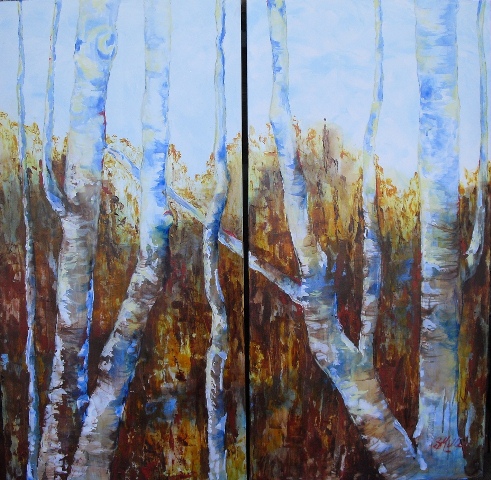
In Part One, we did prep work and underpainting. In Part Two, we did negative painting and some highlighting on the tree trunks. Now, I needed to blend out the stark white on the lower trees, paint upper trees, balance out the values with final glazes, and add the final "tender touches."
To knock down the gesso white on the lower trunks, I used an almost-dry foam brush and added light glazes in local color. That is, where the underpainting was blue, I glazed over the white with blue. Where the underpainting was burnt umber, I glazed over the white with burnt umber. (This doesn't actually result in polka-dot trees, although it seems like it would.) Here's a before-and-after detail:
Note that, except for wisps around the edges, most of the tree trunk is not painted. The trunk colors are the original blue/brown/yellow underpainting showing through. If I was working in watercolor (acrylics versus watercolor again!), I'd have made the underpainting even lighter and used some mid-tones to model the trunks.
Now, the bottom trunks were largely done but the tops were absent. The sky looks very white in these photos, but it's actually a subtle mix of cerulean blue and white.
I used a very watered-down ultramarine blue, a small foam brush, and a chunk of kitchen sponge to lightly model the trees against the sky. I didn't want them too dark, because I wanted the primary emphasis on the lower trunks:
The trunks looked nice but needed heft and highlights. Because the sky behind the trunks was very light and cool, I switched to a cooler color - cadmium yellow pale - and liberally mixed it with white gesso. I laid that on pretty thickly with a foam brush:
Here, i stopped a bit. Usually I am a compulsive overworker. At each stage, I was muttering to myself the good painting adage, "Stop when you feel it's not quite finished." After some pacing and peering, I went back in with the final touches. These are too subtle to photograph, but for anyone trying to step-by-step with me, here they are:
1. Carried some "sparkles" of the cad yellow/white light down into the lower tree trunks . . . just a few, though!
2. Used a little burnt umber to lose the edges here and there in the lower tree trunks.
3. Added very tiny flashes of "surprise" color here and there; in this case, cadmium red.
An instructor of mine once called these "tender touches" - I've also heard them called "jewelry," as a reminder that they should be applied with some restraint.
So . . . trees! Now I let them dry, then went back in with a glazing medium for a sealing topcoat. Late last night, I put on the hardware. The painting won't actually be bone-dry for a couple weeks, but it's safe to transport. So transport it I will . . . with dispatch!
More lovely news: I already have a purchase offer on the painting. So Mom was right, as Moms so often are. Thanks, Mom!
I must here add a coda about soul. I didn't expect to feel connected to this painting. But it had to be done so quickly, and from such a devil-may-care place, that it turned out to be a really joyous exercise. I had to rely on what I knew, instead of fussing and worrying about whether I was doing things "right." As a result, it ended up being painted very much from the heart rather than the head.
I guess there's a moral to this Tale in Three Parts: sometimes love sneaks up on you.
August 24, 2011 - Aspen Trees Step-by-Step (Part Deux)
"Well begun is half done."
- att. Mary Poppins, but see InfoPlease Sources
The love story continues, with warm thanks to Judi of Approachable Art for the kind comment that has inspired me to promptly carry on!
In Part One, we discussed the project genesis -- read: "Holy expletive-deleted, I've got to deliver this for exhibit in four days!" -- initial underpainting, and value sketch. Now begins the fun/messy part.
On Monday morning, I sketched the trees freehand in charcoal and then mixed up nice big puddles of burnt umber, diox red, and Indian yellow (again). As a condiment, I added about a quarter-cup of Golden Regular Gloss Gel to the palette (it's worth every penny).
I then used a painting knife to begin negative-painting the background; this is a watercolor technique but can be used with any medium where you are glazing darker colors on top of lighter ones. To change up the opacity of the pure paints, I smudged gloss gel over the wet paint at irregular intervals.
Here is the result, looking pleasantly soft and moody:
To get a translucent effect where background meets sky, I double-loaded the painting knife with pure Indian yellow and pure gel medium, then twisted and turned the tip of the painting knife to gently smoosh them together on the canvas. (This is a watercolor technique; if I was working in watercolor, I'd be using water instead of gel medium for similar effects).
Things were rolling along so well that I stuck with the painting knife and laid in highlights on the tree trunks with white gesso. I would hesitate to duplicate this step in the future, though; I had to spend significant time later to soften these hard edges:
At the end of this step, the painting had entered the "Ohmigod stage." This is shorthand for, "Ohmigod, this looks so bad that I am going to burn all my paintbrushes immdiately and enroll in stockbroker school."
The only solution to the OMG stage, however, is to take a deep breath and paint right through it. So that's what we will do in the next and final entry.
August 23, 2011 - Aspen Trees Step-By-Step
The changing colours of its fruit
Have dowered the stars with merry light;
The surety of its hidden root
Has planted quiet in the night . . .
- W.B. Yeats
In this entry, and probably the next, I shall detail a love story. For those who like spoilers, here's how it ends:
Okay, I confess, it was an arranged marriage that grew into a love story. I was under deadline for a size-large painting to run across two canvases. Several grand plans for clever compositions failed to gel, one after another, while the clock ticked down. As I dipped one toe into the panic pool via phone, my genius mother -- a highly accomplished artist herself -- suggested, "Paint trees. They are vertical, everybody loves them, and they go really fast."
Inwardly, I gasped in horror. After all, wasn't my very last blog entry about painting with soul? How, then, could I face compromising the ambition to meditate, contemplate, and connect with every subject?
Easily, it turned out, when you're whining to your mother from the playground on a fine Sunday afternoon and the artwork is due for delivery on Thursday morning.
So, immediately upon returning home, I handed a foam brush to my toddler with a promise that we'd be painting in color today.
"Hep Mom payn! [help Mom paint!]" she chortled with delight, twirling around and around with the foam brush. Excellent; that's exactly the kind of enthusiasm that I needed!
We laid out the canvases in the garage, and my little one merrily "hepped" me prime them. Then she took a very great interest in the mixing of cerulean blue and white gesso, and again "hepped" me swirl in both colors for a high, clear, cool autumn sky.
At this point, happily, her attention span, our paint, and my patience all ran out at the same time. (Baths, also, were desperately needed.) After tucking her into bed on Sunday evening, I completed very washy underpainting of burnt umber, ultramarine blue, and Indian yellow:
Then, just before bed, I did my traditional value sketch in hopes that my my brain would work overnight on the exact method needed to alchemize scumbles into trees:
More to come in the next entry.
August 16, 2011 - Banking on the Possible
But am betroth'd unto your enemy;
Divorce me, untie or break that knot again . . .
- John Donne
Today's stumper: can "soul" be snuffed? Or does it just go dormant from time to time?
For several months, I've been intensely thinking about what separates good artwork from good art work. The answer that keeps coming back -- from multple channels -- could be translated as "soul." Said otherwise, the artist has something to say, and that something is best -- perhaps exclusively -- capable of being visually expressed.
That's so very not a bad thing. Today I had the privilege of purchasing a painting that is technical, intense, and strong, yet utterly and deliciously reeking of soul. (I'll post the link here after it's safely delivered and enshrined upon my wall, because I love it that much.)
Earlier this month I had the pleasure of viewing artworks in fiber that also hummed and resonated with soul. The creator of those works doesn't put them out into the public. Although I think the public is missing out, I feel, again, privileged to have seen them.
I did not anticipate, though I should have anticipated, that seeking out such company, such influence, ultimately would cause/require my own strings to murmur again.
[N.B. - I had to shelve that line of pondering for the moment, because I suddenly found myself at a nexus of laundry buzzers, the Tinkerbell movie, a spouse home from work, a dog pawing at me for dinner, and a toddler needing a snack. So I wondered, "Am I fussing at myself for a lack of soul? Or could it be that I just can't hear the darned thing over the local daily ruckus?"]
When I was twenty-something-ish, a person very special to me returned to our hometown after a long absence. We met for a drink and awkwardly compared notes.
"So," he said, "you're not painting? Acting? Any of that now?"
I tossed my head with all the lovely arrogance of a Twenty-Something on the Fast Track to Somewhere and affirmed that indeed, I had put all such childish things behind me.
"No capes? No poet shirts? Not even . . . bows on your shoes?"
No, no such foolishness!, I averred, avowed, and affirmed. (I must have painfully convincing, because 15 years down the road I still remember -- and do not like the memory of -- the quiet look in his eyes at that moment.)
At that time, I had reasons to shove everything creative into a heavy strongbox and lock it up treble and toss the key far, far, far into deep thickety thickets. At that time, I was much-differently wired. At that time, I could see a clear path, but I didn't like the price tag. And they say that "if you have to ask, you can't afford it," right?
Fast-forward: I no longer believe that creativity equals craziness. This is certainly a frequent misconception of artistic twentysomethings: I forgive myself.
Further, I no longer believe that there's any particular merit to craziness-qua-craziness. It doesn't make you special. It just makes you crazy.
Further still, I believe that good art work -- three words, in italics -- comes from a serious place of study and discipline. There is always a place for the native genius, the brilliant naive, and suchlike, but the firm ground where I want to stand is underpinned with good skills and good training.
The question, then, is whether an artist/actress [turned] paralegal/lawyer [turned] artist again can complete that emotional triathlon with any tread left on the soul-tires.
I can recover the technical skills. Some never went away, and some even have improved with age and patience. But can I do this kind of painting again?
I'm banking on the possible. I'll let you know.
August 8, 2011 - Thinking In Squares
Sa’id envisions lines in the sand.
The pieces are not yet framed in glass.
-- "Deryk," Chess Sans Voir
I am trying to solve a problem of composition.
[N.B. - Said problem-solving is not made easier -- albeit not made significantly harder -- by the tweedling of a kiddie show on the television and the occasional soprano piping at my knee: "Mama, pease I can haff . . .[item]?" [Item] can be anything, but basically it translates to "undivided attention." She is my delight.]
This week, I completed a 4x4 (foot) artwork for a commercial space, Local Market in Golden, Colorado. It was a sound project, with sound subject matter, and I am glad to have it ready for their ribbon-cutting on August 22. (Yes, it will be for sale. You can preview it here.)
Now, to balance the other side of those large walls -- and in part just to see if I can do it -- I want to do another 4x4 in the next ten days. I further want to do the second painting as a diptych. This presents some interesting problems, because my panels are 2x4 feet each, but mountains tend to be horizontal-ish things.
So. How to create two separate canvases where the images flow across as a single composition, yet keep each canvas standing on its own as a complete painting?
This problem was well-solved, over and over again, by Marcel Mouly. Although they are single images, if you divide any of his images into quadrants, each quadrant is a beautiful complete composition. Here's a nice collection for that game.
Oh, and if you'd like to purchase any little somethin' somethin' for me from that Mouly site, as an unbirthday present or for any other reason, please be my guest.
Subscribe to:
Posts (Atom)